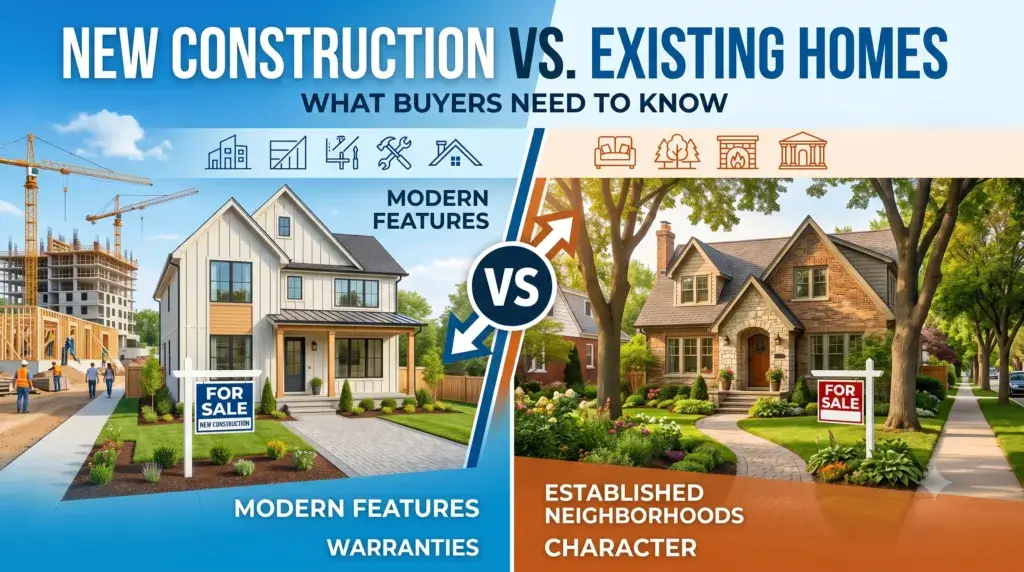
After more than fifteen years helping families across Central Texas buy and sell, one of the most common crossroads I see clients reach is this: should you buy an existing home or build new? There’s no single right answer. Both paths have real advantages and real pitfalls, and the right call depends entirely on your goals, your budget, your timeline, and what’s happening in the market the moment you’re shopping. Let me walk you through how I think about it with my own clients when deciding between New Construction vs Exiting Homes.
Understanding New Construction vs Exiting Homes
Whether you’re leaning toward new or existing, the process begins identically: a conversation about your goals and objectives. Most of the time, people are trying to get into a specific location—usually driven by schools, work, or both—and we start by talking about proximity to those things.
From there, I want to know whether you’re open to new construction, existing homes, or whether you have a hard preference. A lot of folks tell me they want a mature neighborhood—established trees, finished lawns, that settled feel. And here in Central Texas, that often points you toward existing homes, because while there are pockets of newer construction closer in, most new builds are out on the periphery, in the suburbs.
I get clients on both extremes. Some say, “If it’s not new, I don’t want it,” or “If it’s not within five years old, I’m not interested—too many problems with older properties.” Others come at it from the opposite direction: “I think I can get more value in an existing home. I’ll pay less, I know there’ll be maintenance over time, but I can upgrade it and add value myself.” Both points of view are valid. It’s all situational, and it’s all market-specific.
The Market Has Shifted the Math
Here’s something I rarely used to see: earlier this year in Central Texas, for what’s probably the first time ever, we started seeing new construction pricing come in line with existing homes. That’s unusual, because new construction is almost always more expensive out of the gate.
I also came across an analysis recently—and these are ballpark numbers—suggesting that buying new construction and holding it for ten years can save you around $25,000 in efficiencies, HVAC, and other systems you’d otherwise have to replace in an existing home over that same stretch, unless that work has already been done.
That said, you have to keep the full picture in mind. The base cost on a new construction is just the base cost. When you compare a new build’s base price to an existing home, understand that you’re typically looking at $30,000 to $60,000 more in incentives and upgrades, depending on the level of home. I’ve had clients tell me, “We’re not flashy, we’re going minimum, minimum”—and it’s still twenty grand. We all want what we want once we’re in there, and that number tends to creep up. We’re all restricted by our budgets, but we also want things in our new house.
Vetting an Existing Home
If you go the existing-home route, you have to check it out just like you’re buying a used car. What’s the condition of the roof? The HVAC? The water heater? Has the property had floods or fires in the past? All of these things need to be vetted so you know exactly what you’re buying.
The Advantages of Buying New
On the new-construction side, yes, you may pay a bit more up front, though as I mentioned, that’s situational right now. But you get those efficiencies, and there’s real comfort in being able to pick up the phone for the first year or two and say, “Hey, this is broken—fix it,” without paying a dime because it’s under warranty. Your electricity bills and other costs benefit from the highest efficiencies, too.
There’s another advantage that really came into play during the pandemic years, when we were dealing with brutal bidding wars. If I had clients who’d lost out once or twice on existing homes, I’d often steer them toward new construction. Even though there were some bidding situations back then, frequently if you got into the builder’s lottery—or if they hadn’t started one yet—you were in to get that house. You didn’t have to live through the stress of bidding, hoping, and losing.
Do You Need a Realtor When Buying New?
This is a question I hear all the time, and my answer is yes. Some of the nicest people in the world work in those model homes, and there are good people everywhere—but you have to understand that the folks in the model home work for the builder. Their objective is to sell that builder’s product to you.
Here’s something a lot of buyers don’t realize: builders typically put an allowance in their marketing budget to cover the compensation for buyer representation. Now, things have changed over the last few years regarding who pays what, so all of that has to be discussed up front between the realtor, the builder, and you. But generally, having representation isn’t coming out of the home’s sale price.
I’ll be honest about the landscape, though. Some builders make a concerted effort to be, let’s say, not realtor-friendly. And it’s interesting—when sales are down, they’re throwing bonuses and parties at us because suddenly they need us. When things are good, they don’t. I’ve seen situations where a builder told my client behind my back that they could cut a better deal without me in the room. That’s unethical, and I tell my clients plainly: if you choose to go that route, understand who you’re working with. But many builders genuinely market themselves as pro-realtor, and remember, that compensation comes from a dedicated marketing budget that doesn’t affect your sales price.
Why I Insist on Third-Party Inspections—Even on New Builds
Builders will tell you, correctly, that they go through permitting and inspections with the county throughout the build. But I always recommend third-party inspections on top of that. On a ground-up build, there can be as many as four inspection points: foundation, pre-drywall, pre-close, and post-close.
A quick tip from how I run my own inspections: I advise clients to join only for the last thirty minutes. The last thing you want is to distract the inspector with questions while he’s working. Let him do his job, then get the highlights at the end.
Why does this matter so much? Because it’s not always the builder—it’s the subcontractors. If a crew is off or cutting corners, a third-party inspection catches it. I’ve had clients go through the whole process and only find a few minor things, and I tell them: good, now you know you’ve got a solid house, validated by someone independent for a few hundred dollars. On the other end, I’ve seen genuinely serious problems caught—including an AC unit installed backwards. Imagine taking possession of a house in the Texas summer with no working AC. The builder isn’t going to drop everything to fix it when they’ve got a hundred more homes to build. Every minute without AC in a Texas summer is excruciating. Catching that before you take possession is everything.
Be Present for the Selection Process
I’m a little different from a lot of realtors here: I’ll actually attend selection meetings with my clients, on both production and custom homes. I offer it as a service. Sometimes I’m just the tiebreaker between the husband and wife, but mostly I’m giving the realtor’s perspective on the choices being made.
I had a client about to choose silver carpet. I asked, “You’ve told me you have a dog, right? And you’re planning on having kids in the next year?” Yes and yes. I said, “I’m not sure silver carpet is conducive to either of those.” They changed it, and for years afterward they thanked me. Some clients say, “We’ve got this,” and that’s perfectly fine. But for the ones who want me there, I sit through the selection meetings and verify exactly what they’re getting and what they were promised—so that if something goes crosswise later, I have the documentation to hold the builder’s feet to the fire and make sure my clients get what they were told they’d get.
Get It in Writing—and Ask for What’s Advertised
I’ll give you a real example. I sat down with clients to write a contract, and I started running through the list: garage door opener, sprinkler system, full sod, fencing, blinds, washer and dryer. A lot of what came back was, “No, we don’t do that.” So I said, “That’s interesting, because I’m looking at your webpage right now, and I have a snapshot of it, and it says all of these things come with this house in this timeframe. So I think we’ll be asking for them.” Suddenly, my clients were getting items they otherwise wouldn’t have. If a builder advertises something to get you in the door, hold them to it.
You Have to Ask for the Money
Before I got into real estate, I bought a new construction unrepresented. My wife has a mortgage background, so she knew more than I did at the time. We walked into the model home to sign, feeling good about our rapport with the rep, excited about the house and the dream of it all—which is exactly what happens to buyers. The rep asked, “What are you going to offer?” I looked at my wife, then asked, “What do people typically offer on a house like this?” He told me about $20,000 under asking. I said, “That sounds about right—we’ll go with that.” They approved it that day.
That rep saved me $20,000 by being a nice guy. He didn’t have to, and I never would have known to ask. Once I got into real estate, that lesson stuck with me. Now, every time I walk in with a client, I’m thinking: there’s money on the table to be had—you just have to ask for it. You don’t always get it, but you might as well ask. And especially in a market like the one we’re in now, where houses aren’t flying off the shelves, this is exactly the time to be asking.
New Construction Is Often More Cookie-Cutter
Depending on your price point, you should know that newer neighborhoods—particularly in the lower-to-mid range—tend to be more cookie-cutter than existing homes. Some would argue the rooms are smaller. It really depends on the builder and the area; I’ve seen plenty of new construction with very sizable rooms and varied lots. Certain builders specialize in smaller, starter-type homes, while others build for the mid-tier buyer who’s owned before and wants something a little nicer. You have to figure out your trade-offs, and it all starts with the budget.
The Most Important New-Construction Consideration: How Long Will You Stay?

If there’s one thing I want you to take away about buying new construction, it’s this. When you buy early in a community’s phases—and many of our Central Texas communities have multiple builders—you need to think hard about how long you plan to stay.
If you try to sell in a year or two while the builders are still active around you, you’ll be competing directly against them. And they can throw a cra ton of incentives at buyers and crater the price you were hoping to get. It’s simple for a buyer: “I can buy your house, or I can buy this brand-new one over here.” You’ll typically leave money on the table.
Now, life happens—job transfers, health changes, things you can’t predict. But I always have this conversation up front. I had a client buy in Santa Rita Ranch six or seven years ago, when it had something like twelve builders at one point. They were older, and I asked, “Are you planning to be here? I know you’ve had some health concerns.” They assured me they were close to the hospitals and had checked everything out. A year later, they called wanting to sell. In a single year, it’s hard to make the numbers work anyway—there’s often a tax impact if you haven’t been there two years—and on top of that, they were now competing against all those builders, plus closing costs and everything else. I told them honestly it would be very hard to get what they wanted out of it.
Nobody likes hearing that. I ended up losing that listing because I told them what they didn’t want to hear, and they went with someone who told them what they did. They still ended up selling, and they didn’t get anywhere near what they’d hoped. I could’ve taken the listing and just weathered it with them, but I wasn’t going to do that.
There’s a related question buyers should ask themselves: should I put a lot of money into upgrades if I know I might be moving? In a still-developing neighborhood, you might not get that money back—though it can cut both ways. If you customize your home enough to stand out against the cookie-cutter builder inventory, that can actually help you sell. It’s nuanced.
A Word on Budget—and Breathing Room
Let me tell you how I handle budgets, because this matters whether you go new or existing. People usually tell me a personal budget, not what they’ve been approved for—and you can get approved for some big numbers. When a client tells me their budget and parameters, I usually push it a little, and I tell them up front I’m going to. If you say 500, I’m going to show you up to 550. If you tell me you’ll drive fifteen minutes, I’ll put thirty in. I’d rather show you a house and have you say no than have you find out later you missed the perfect one because it was ten minutes farther or twenty grand more.
People search online in $25,000 increments, so if your max is 500, I’m taking you to at least 525—because what happens if the perfect house is listed at 501, or 507? You’d never even see it.
I had clients two years ago who would only drive fifteen minutes from work. I told them, “Give me another ten, and I can get you a new construction with some great deals.” They went, saw the house, and said, “You were right. We should’ve listened to you.” An extra ten minutes a day was fine with them. When my wife and I moved from Dallas, we wanted the equivalent of what we’d sold. But everything in our original price range down here had hair on it—older homes, some problem with each one. We went up about thirty grand and bought a house that was four years old and absolutely perfect, and it still fit our budget.
The flip side is just as important. I have clients approved for, say, $500,000 who only want to look at $700,000 homes. I stop them and ask, “Is there money I’m not aware of? A gift from someone?” Because the last thing I want is to show you a $700,000 home you fall in love with and can’t afford, then have you compare everything else against it. If it doesn’t do you any good, it doesn’t do me any good.
I once had a client pushing well above his approval. He had a young family, and I told him, “There’s going to be sports and expenses you’re not even prepared for yet. Buy something a little less expensive and give yourself breathing room.” He looked at me like I was crazy—he was set on that house. I told him, “If that’s what you’re going to do, I’ll help you do it.” But many times since, he’s come back and thanked me. He loves the house he’s in, it cost far less, and he’s said he doesn’t know how the other one would’ve worked out.
That’s what you hire me for—to tell you the truth even when it’s not what you want to hear. If you were my brother, I’d tell you the same thing: that’s a bad idea, and here’s why. Most people appreciate that. Some don’t, and that’s okay too.
The Bottom Line
Whether you buy new or existing, it all comes back to your goals and objectives—what you’re trying to accomplish, where you need to be, and what your real budget can handle. If you’re driving an hour to a new community, that house had better be fabulous. If top-tier schools are the priority, that has to factor in. We go down the list of your needs and wants, because if we’re not starting there, we’re not on the same page, and you won’t end up happy.
So if you’re weighing new construction against an existing home, let’s sit down and talk it through. That’s where every good real estate decision starts.