
Why Families Are Moving to Austin
It’s no secret: Austin has become one of the hottest relocation markets in the U.S. Over the past decade, tech giants like Apple, Google, Dell, Oracle, and Microsoft have made Central Texas a core hub for jobs and innovation. That growth has fueled a wave of families moving here from California, New York, Seattle, and beyond.
But relocation is about much more than chasing a new job. Families quickly realize the move comes with questions about schools, neighborhoods, commutes, and what day-to-day life really looks like in Central Texas.
The good news? With the right plan, relocating to Austin can be one of the best moves your family ever makes. By the end of this article, you’ll understand the key things to know before packing the moving truck — from housing and cost of living to schools and transportation — and how to find the right community to call home.
👉 Want a step-by-step relocation checklist? Download our FREE Ultimate Relocation Guide today.
Austin’s Tech Boom and Job Market

Austin didn’t get the nickname “Silicon Hills” by accident. What started with Dell decades ago has blossomed into one of the strongest tech ecosystems in the country.
Major Players
- Apple: A $1 billion campus in North Austin, employing thousands.
- Google & Meta: Large downtown offices, with ongoing expansion.
- Dell: Still a cornerstone employer, headquartered in Round Rock.
- Oracle: Recently relocated its headquarters to Austin.
- Samsung, AMD, Tesla, Cisco, Salesforce: All have a major presence in Central Texas.
Why Families Relocate for Work
This density of employers creates job security and career growth. For tech professionals, Austin offers opportunity without the cutthroat pace or overwhelming costs of Silicon Valley. Supporting industries — startups, professional services, and healthcare — are also booming, which makes Austin attractive for spouses and partners building their own careers.
In short, relocating here isn’t just about one job — it’s about long-term career stability in a region built for growth.
Housing Market and Neighborhoods
If jobs bring families to Austin, housing is what keeps them here. Choosing the right neighborhood is the most important — and often the most stressful — decision families make when relocating.
Hot Relocation Markets
- Round Rock: Strong schools, family-friendly, close to Dell and the North Austin tech corridor.
- Cedar Park & Leander: Booming suburbs with master-planned communities, Leander ISD schools, and easy access to Apple and other North Austin campuses.
- Dripping Springs: Hill Country charm, top schools, and more acreage for families wanting space.
- North Austin Corridor: Convenient to Apple, Samsung, and The Domain shopping/entertainment district.
Price Ranges and Trends
- Austin metro median home price: ~$475,000.
- Suburbs like Leander and Cedar Park: mid-$400s to mid-$600s for family homes.
- Dripping Springs and West Austin: $600,000+ for acreage or newer construction.
Housing costs are higher than rural Texas but remain far below San Francisco, Seattle, or New York. Strong demand has driven appreciation, making Austin housing not just a place to live, but also a smart long-term investment.
👉 For a deep dive on family-friendly neighborhoods, see our article: The Best Neighborhoods in Central Texas for Families Relocating for Work.
Cost of Living Compared to Other Tech Hubs
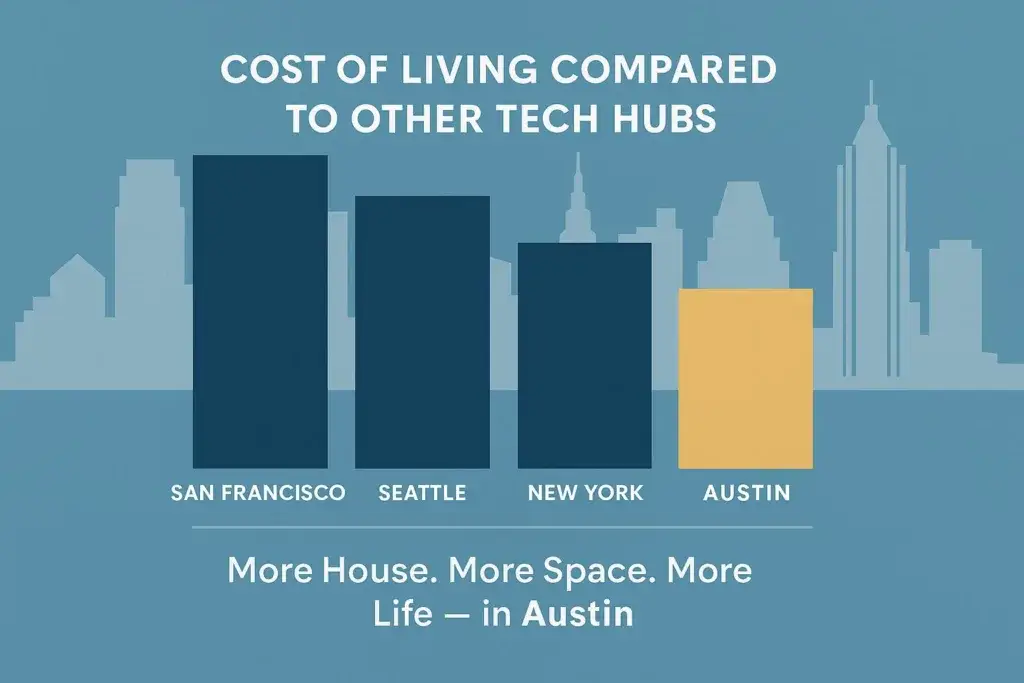
One of the biggest questions families ask is: “How does Austin compare financially?”
No State Income Tax
Texas doesn’t collect state income tax. For a household earning $200,000, that can mean savings of $15,000–$20,000 per year compared to California or New York.
Housing Costs
Yes, Austin housing prices have risen. But compared to other tech hubs:
- San Francisco: $1.2M+ median home price.
- Seattle: $750,000+.
- New York City: $680,000+ (varies by borough).
- Austin Metro: ~$475,000.
Families often find they can afford larger homes, newer construction, and better schools for the same or less than they were paying before.
Everyday Costs
- Utilities: Affordable, though air conditioning in the Texas summer adds up.
- Groceries & Dining: Around the national average, with both budget-friendly and high-end options.
- Childcare: Cheaper than coastal metros, averaging $900–$1,200/month per child (vs. $2,500+ in San Francisco).
👉 For a full cost breakdown, see our article: What Families Need to Know About the Cost of Living in Austin.
Schools and Family Lifestyle

Families moving to Austin aren’t just looking for jobs and houses — they want confidence in the schools and a lifestyle that makes the move worthwhile.
Public School Districts
- Round Rock ISD: Strong academics and extracurriculars, close to major tech employers.
- Leander ISD: Rapidly growing, highly rated, with strong music and sports programs.
- Eanes ISD: Elite reputation in West Austin, consistently top-ranked in the state.
- Dripping Springs ISD: Smaller district with a strong academic record and Hill Country community feel.
Private & Charter Options
Austin also offers top-tier private schools like St. Stephen’s, St. Andrew’s, and Regents, plus charter networks such as Harmony and IDEA. Families relocating from larger cities often appreciate having these alternatives.
Family Lifestyle
- Outdoors: Lake Travis, Barton Springs, and endless greenbelts.
- Sports: Youth leagues, high school football culture, Austin FC soccer, and the Round Rock Express baseball team.
- Culture: Music, food, and festivals like ACL and SXSW make Austin a city where parents and kids alike find things to enjoy.
👉 For a complete breakdown of school districts and family activities, see our article: Schools, Activities, and Family Life in Central Texas.
Commutes, Traffic, and Transportation
Let’s talk about the elephant in the room: Austin traffic.
Commute Realities
I-35, Mopac, and 183 all bottleneck during rush hours. Living 15 miles from work doesn’t always mean a 15-minute drive. For many families, commute times are the deciding factor when choosing a neighborhood.
Suburbs vs. Closer-In
- Suburbs (Round Rock, Cedar Park, Leander, Dripping Springs): Larger homes and top schools, but 30–60 minutes to downtown.
- Closer-In Neighborhoods: Higher prices, smaller lots, but shorter commutes.
Alternatives
- CapMetro: Limited bus and rail options, useful in certain corridors.
- Toll Roads: SH-130, 183A, and Mopac Express lanes can cut commute times.
- Airport Access: Austin-Bergstrom offers direct flights nationwide.
👉 For detailed commute tips, see our spoke article: Getting Around Austin: Commutes and Transportation Tips for Relocating Families.
Work With a Relocation Realtor®

Relocating isn’t just about picking a house off Zillow. It’s about balancing schools, commutes, budgets, and lifestyle goals in one of the most competitive housing markets in the country.
That’s where working with a relocation Realtor® makes all the difference.
Why Local Expertise Matters
- School boundaries change often, and some neighborhoods appreciate faster than others.
- Commute times vary dramatically depending on which side of the highway you live on.
- Local insight helps families avoid costly mistakes and find neighborhoods that truly fit their needs.
Richard Fowler’s Approach
Richard specializes in guiding tech families through the relocation process. He combines neighborhood knowledge, school insights, and investment savvy to help families make confident choices. His focus isn’t just finding you a home — it’s setting you up for long-term success in Central Texas.
👉 Download the free Ultimate Relocation Guide To Austin for relocation tools, then schedule a consultation with Richard Fowler to start your home search.
Make Your Move With Confidence
Relocating to Austin isn’t just about changing addresses. It’s about stepping into a thriving job market, choosing the right neighborhood, managing costs, securing schools, and navigating traffic in a city that’s growing fast.
To recap:
- Tech Boom: Job security and opportunity in Silicon Hills.
- Housing: Strong appreciation, family-friendly neighborhoods.
- Cost of Living: More affordable than coastal hubs, with tax advantages.
- Schools & Lifestyle: Top districts, outdoor living, and cultural life.
- Commutes: Manageable with planning, tolls, and smart location choices.
👉 Ready to relocate with confidence? Download your free copy of the Ultimate Relocation Guide To Austin for a full relocation checklist and insights on the best family neighborhoods.
Because when it comes to moving to Austin, success isn’t just about finding a house — it’s about finding a lifestyle and investment that fits your family’s future.