
Most people think a real estate negotiation comes down to a single number. You want to sell for the most, the buyer wants to pay the least, and whoever blinks first loses. After years of doing this in Central Texas, I can tell you it is almost never that simple. The number matters, but the real work happens underneath it, in your goals, your timeline, and what is actually moving in the market. This week on the show, Jeff and I walked through how I handle negotiation on both sides of the table, so here is the playbook I use.
Key Takeaways
Negotiation is specific to the client, not a one-size-fits-all script, so it starts with your goals and the current market, not a list price. In today’s Austin market, creative terms like rate buydowns, concessions, and seller leasebacks often matter as much as the price itself. The biggest mistakes come from unrealistic expectations and agents who aren’t truly in sync with the people they represent.
Where does a real negotiation actually start?
Not with the house. It starts with a conversation about your goals, your objectives, and your budget. When someone comes to me to buy, I want to understand their job, lifestyle, and what they are really trying to accomplish. When someone comes to me to sell, I ask what is driving the move. Some sellers have already bought the next place and need to move quickly so they are not carrying two mortgages. Others have all the time in the world. Those answers change everything about how we position and how we negotiate.
From there, I overlay your situation with market conditions and what is actually happening out there right now. That combination, your goals on top of the real market, is where I find the wins for you. It is easy for everyone to say sell high and buy low. The nuance is in the layers underneath, and those layers are different for every client.
What is actually working in today’s market?
Positioning. I have a listing right now in a new construction community, which means we are competing directly against the builder and their ability to tweak pricing and pile on incentives. The big one these days is the rate buydown, because everyone is hyper-focused on the interest rate. Builders are offering reduced list prices, help with closing costs, rate buydowns, or simply a percentage of the sale to use however works best for the buyer.
To compete with existing homes, you have to get creative in the same way. On one of my current listings, we set it up at one price but already built in money that can be used for closing costs, a reduced price, or a rate buydown. So it shows at one level and is effectively offered at another to stay competitive. We even put the refrigerator, washer, and dryer on the table to offset what the builders are doing. The good news for buyers is that the leverage has shifted. Per Unlock MLS, as of August 2026 the Austin metro median sale price was about $412,000, with homes closing at about 93 percent of list. More than 40 percent of active listings had already taken a price cut, a clear sign sellers are competing, and buyers have room to ask for terms (Unlock MLS August 2026 Central Texas Housing Report, Team Price Austin briefing, Aug 2026).
How does a rate buydown really work?
A buydown lets you ease into the mortgage rate instead of starting at the top. Say the going rate is around 7 percent. With a 3-2-1 buydown, you might start near 4 percent the first year, step up to 5 percent the second year, 6 percent the third year, and land at the full 7 percent in year four. There are also two-one versions and simple one-year buydowns. Builders love these right now because they buy mortgage rates in bulk and spread them across their buyers.
The one thing you have to understand as a buyer is that this is an adjustable payment, and it will go up. Adjustable structures have mostly gone away, and now we are seeing them everywhere, so you need to run the numbers for the years after the buydown ends and make sure you are prepared. And even if you are buying new construction, talk to a realtor who can walk you through what the builder is really offering, because they will put things in front of you that you have never seen before.
What is negotiable besides price?
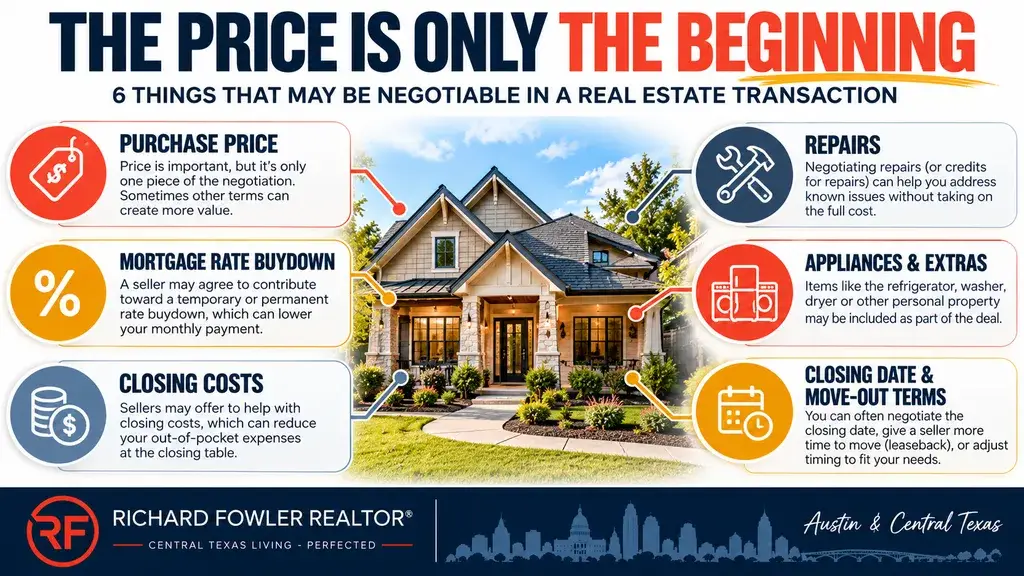
Almost everything. I tell clients the whole adage is true, everything is negotiable in real estate. Maybe a buyer wants the couch, or the washer and dryer, or the refrigerator. The question I ask my seller is simple. How important is that item to you? If keeping it means you just turn around and buy another one, and letting it go helps the sale, that is your call to make. Sometimes the smart move in this market is to let the appliances convey rather than pay to move them.
Terms can be just as powerful as price. A seller leaseback, where the seller rents the home back for a set period after closing, solves a very common problem. One of my sellers needed time before moving into their next place, so the buyer let them lease it back for about 60 days. I had another situation where I brought my client a full-price, all-cash offer that could close in two weeks. I walked in excited, and he told me he needed more time. More than 30 days, in fact. It turned out his adult children, who grew up in the house but no longer live there, didn’t even know he was selling, and he felt he needed their blessing. We ended up closing the sale with a six-month leaseback, which only worked because the buyer was doing a 1031 exchange and needed to rent it anyway. Real estate is personal, and legacy properties and family ranches bring that out even more. Part of my job is asking the right questions up front so those needs become part of the deal, not a surprise at the finish line.
How do you price to sell without scaring buyers off?
It starts with a frank conversation and the data. I pull the numbers, I share them, and I explain what is really happening in your market. I will show you the homes sitting for months because they are priced for yesterday, and I will show you the price reductions happening week to week. Then I set realistic expectations before we ever go to market. If the number you need does not line up with what is moving, I will tell you this may not be the time to sell, and sometimes the better move is to lease the house out and wait for the market to recover. My job is to give you every scenario and let you decide.
I also believe information is power, so on most of my listings I recommend a pre-list inspection. Think of it as a Carfax report for your house. You may think you know everything about your home, but you do not know what is behind the walls or up in the roof until someone looks. I had one listing with 60 windows, and 30 of them had broken seals. Rather than let that become a negotiation later, we priced it in, took the windows off the table, told buyers it was already handled, and that house sold in about seven days with no back and forth over the windows. Doing the work up front removes the ammunition a buyer would otherwise use against you.
What do agents get wrong in a negotiation?
Two things, mostly. The first is not having realistic expectations given the market. The second is not being in sync with their client. Agents can be competitive, and I have to remind myself constantly that it is not about me, it is about my client. I might think we could push one more round and squeeze out a little more, but if my client is happy with the deal in front of them, my job is done. I had a negotiation once where both sides were dug in over 2,000 dollars on a home that had been sitting for a while. Rather than let the deal die, I called the other agent and offered to kick in 1,000 dollars of my commission if she would do the same. We both did, and the deal closed. I don’t do that on every deal, but in that case, the best outcome for my client was worth giving up a little of my check.
The last piece worth understanding is that commissions are negotiable now, and that cuts both ways. Some buyers hear that and assume it means they owe their agent nothing. In a competitive market, that is exactly backward. You want agents motivated to show your home and bring real offers. A good agent earns their keep through everything you don’t see: the research, the house prep, the marketing paid out of pocket, and the fact that, on the listing side, nobody gets paid until the deal actually closes.
A few questions I hear all the time
What is a rate buydown? It is a way to lower your mortgage rate in the early years, often stepping up over time, such as a three two one that starts lower and rises to the full rate by year four. Just remember the payment adjusts upward, so plan for it.
Is now a good time to buy in Austin? If you can afford it, there is real opportunity. Prices have eased, many listings have taken price cuts, and there are several ways to address the rate. That combination gives buyers negotiating room they have not had in years.
Can I really negotiate things like appliances or a leaseback? Yes. Appliances, closing cost credits, rate buydowns, and seller leasebacks are all common. The key is to identify what matters to you early so you can build it into the deal.
Should I get an inspection before I list? In most cases, yes. A pre-list inspection is like a Carfax for your house. It lets you fix or price in issues on your terms instead of scrambling during the option period.
The Bottom Line
Negotiation is not about winning a staring contest over a number. It is about understanding what you actually need, reading the market honestly, and getting creative with the terms so the deal works for you. If you are thinking about buying or selling in Central Texas, reach out. Donna and I are always happy to give you a straight, no-pressure read on your situation and your real options.
Written by Richard Fowler, REALTOR with the ARK Property Team at Pure Realty. Published October 5, 2026. Last updated October 5, 2026.