
I got into real estate because of my own first home. We were still figuring out how to pay the bills when my wife, who happens to be a mortgage expert, looked at me and said we needed to buy a house. I thought she was crazy. I remember signing the contract with my hand practically shaking, certain there was no way we could afford to be tied to that number for 30 years. We bought it anyway, and it turned out to be one of the best financial decisions we ever made. That is the experience I bring to every first-time home buyer, so here is the playbook I walk them through.
Key Takeaways
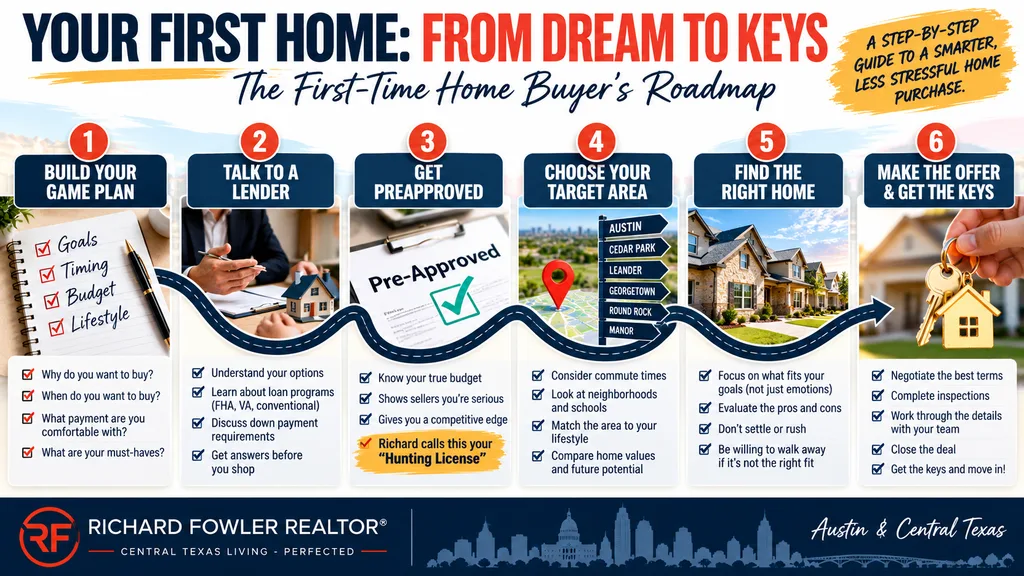
Start before you shop: getting pre-approved is your hunting license, and talking to a lender early, even a year out, can put you in a much stronger position. Do not buy at the very top of your approval, because the number a lender gives you is a ceiling, not a target. And the biggest mistakes are almost never about the house itself; they are about skipping the strategy, so get a collaborative agent who will tell you no.
Where does the process actually start?
Not with houses. It starts with a conversation about what is driving your move and, right after that, a lender. Before I ever get in the car with a buyer (Check out our Buyer Page at: https://richardfowlerrealtor.com/buy-homes/), I want to know what you are approved for, because the last thing I want is for you to fall in love with a home you cannot afford and then measure every other house against it.
Getting there is easier than most first-timers think. If you do not already have a lender, I will give you three recommended, qualified names, and I suggest you talk to at least two, because a lot of it comes down to personality and how well you communicate. You do not even have to be ready to buy. If you tell me you are looking a year out, that is a great time to talk to a lender, as long as they do not run a hard credit pull until we are actually moving. Starting early is a real advantage, because a good lender can restructure your debt or tell you that paying off one car in the next six months will bump you into a better bracket. The goal of all of this is one document: your preapproval letter. That is your hunting license, and once you have it, we go find a house.
How much house should you actually buy?
Usually, less than the bank will let you. When a buyer tells me they are approved for $ 450,000, my first question is whether that is truly their maximum, and then I steer the search below it (https://richardfowlerrealtor.com/listing/). If you are approved for 450, you probably want to look around 400 so the monthly payment leaves you room to breathe. It is your decision, but my job is to keep you from stretching to the ceiling.
It is also worth knowing the difference between a preapproval and a prequalification. A preapproval is lighter, sometimes just answering questions, while a prequalification involves the lender actually pulling your data and taxes, which makes you look stronger to a seller. Most buyers move forward with a preapproval, and as your agent, that hunting license is the minimum I need to start showing homes. From the other side of the table, most listing agents will not take an offer seriously without at least a preapproval or proof of funds, and when two offers are otherwise equal, the more qualified buyer usually wins.
How do you deal with today’s rates and prices?
You use them to your advantage. Prices have pulled back from the pandemic peak, which is genuinely good news if you can afford to buy. Per Unlock MLS, the Austin metro median sale price was about 412,000 dollars in August 2026, with roughly five months of inventory, which is a buyer’s market. That gives you negotiating room most first-timers have not had in years.
Rates are the thing everyone is scared of, so let’s talk about them honestly. On a listing I have going live, I am talking with the sellers about offering a concession the buyer can use as either a price reduction or a rate buydown. We might list at 333 instead of 325 so there is seven or eight thousand dollars in the deal, and the buyer decides whether to knock down the price or buy down the rate. Adjustable rate mortgages have also come back as a tool. They went away for a while, but for a buyer who doesn’t expect to stay 30 years, they can make sense. When I bought one of my early homes on a 10-year ARM, my wife pointed out that we would likely move within 10 years and could always refinance if rates dropped. We stayed nine years and came out ahead. Just remember that an adjustable rate will adjust, so you have to run those numbers too.
On the down payment, first-timers are often surprised at how many paths exist. Plenty of buyers put down 3 percent rather than 10 or 20, and there are FHA options, VA loans (va.gov/housing-assistance/home-loans) with no down payment for veterans, and assistance programs tied to specific buyers and areas. Texas-specific is the Texas Homebuyer Program / TDHCA (tdhca.texas.gov). I am not a lender, so I bring one onto the team along with a title officer, and we run your situation through them to see which boxes you actually check.
What mistakes trip up first-time buyers?
Almost all of them come back to skipping the strategy: the qualification, the timing, and a clear picture of what you are trying to accomplish. I have had clients who could not buy for two years, spent that time repairing their credit, then called me ready to go. I have had others who were sure they could not qualify at all, until one conversation with a lender proved otherwise.
The other big one is settling. On your first house, the temptation is to say “I’ll take it” about the first place with a roof. I once had a first-time buyer walk into five homes and declare each one the one. The favorite backed up to a commercial property, and when we stepped into the backyard, the smell from the dumpster on the other side of the fence nearly knocked me over. She told me she did not go in the backyard much. I reminded her that she would, and that someday one of her buyers would too. We passed on all five, and I found them a home they genuinely loved. As I told her, I did not make the decision for you, I just handed you the ammunition to make it. Part of that strategy is picking the right area, too, because in Austin the north side, south side, east, west, and downtown are completely different experiences, and the right fit depends entirely on how you live.
What do you wish every first-time buyer knew?
Get a good realtor, and interview them like it matters, because it does. You want someone collaborative who will actually tell you when something is a bad idea, not just someone trying to put you into a property. It is not always about who has the biggest numbers. I tell clients up front that I will never be the top-volume agent in my area, because my model is personalized service from the first conversation through and beyond, and you cannot do that at scale. The proof is in how it comes back around. I once spent weeks helping a buyer who ended up getting a better deal and buying in Phoenix, and he still wrote me a glowing testimonial, even though he never closed a sale with me. That is the whole point. We do this to put people in a better place.
A few questions I hear all the time
What is the difference between preapproval and prequalification? A preapproval is a lighter review, often just questions, while a prequalification involves the lender pulling your financials, which makes your offer stronger.
How much do I need for a down payment? Less than most people think. Many first-timers use 3 percent, and FHA, VA, and assistance programs can lower it further depending on your situation.
Should I buy at the top of my approval? No. Treat your approval as a ceiling and target below it so the monthly payment is comfortable.
Is now a good time to buy in Austin? If you can afford it, yes. With prices pulled back and inventory around five months, buyers have real negotiating room.
The Bottom Line
The first-time buyer’s playbook is not complicated, but the order matters: talk to a lender early, get your hunting license, buy below your ceiling, use the tools available for rates and down payments, and lean on an agent who will tell you the truth. If you are thinking about that first home in Central Texas, reach out and Donna and I will give you a straight, no-pressure read on where you stand.
Written by Richard Fowler, REALTOR with the ARK Property Team at Pure Realty. Published September 28, 2026. Last updated September 28, 2026.