
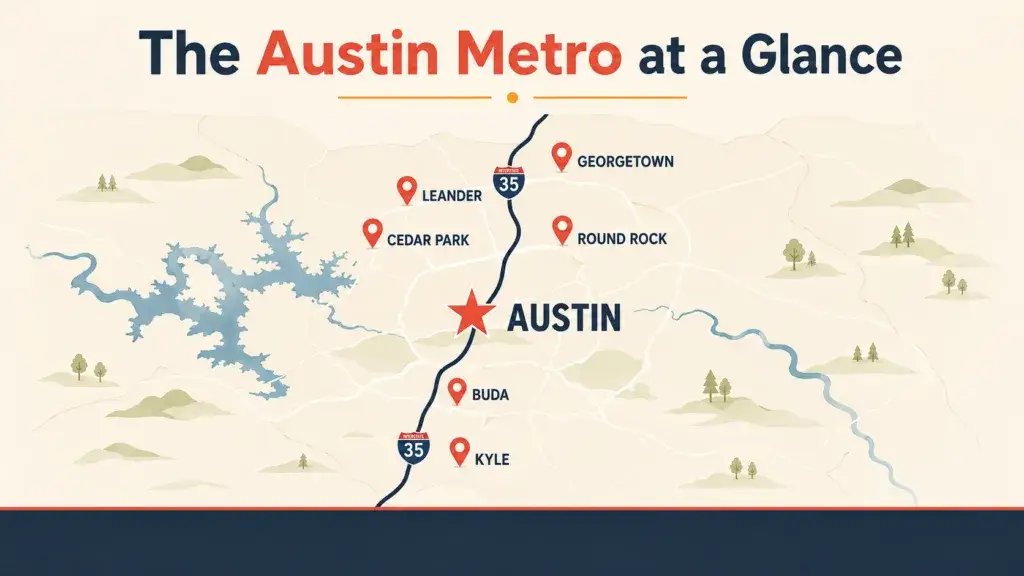
Here is the thing most people do not realize until they get here: Austin is not one place. Living in a downtown condo is a completely different life than living in a suburb with a yard and a school zone, and the towns ringing the city each have their own flavor. We keep Austin weird on purpose. So when a family calls me from Seattle or California saying “we are moving to Austin,” my first job is not to send them listings. It is to figure out which Austin is actually right for them. After 13 years in this market, here is how I help people relocate to Central Texas without the guesswork.
Key Takeaways
Choosing the right suburb starts with your life, not a map: your work situation, your commute tolerance, your kids and schools, and how you like to spend a weekend. Right now, Central Texas is seeing the most buyer-friendly market in years, which changes the rent-versus-buy math. And the single biggest relocation mistake is letting stress push you into a decision you are not ready to make. You have more power, and more time, than you think.
Why does choosing a suburb start with you, not a map?
When someone reaches out about relocating, I start the way you would start a first date. I ask a lot of questions, and I mean it when I say you cannot give me too much information. What are your goals and your timeframe? Do you work from home, or do you need to be near an office? Do you have kids, and how much does the school district matter? Do you have a child with special needs? Every answer helps me position you better.
From there we talk commute. When someone tells me they want to be within 15 minutes of a downtown office, that one sentence eliminates half the map and points us at the right areas. Then we layer on the rest: lot size, style of home, the feel you are after. By the time we are done, we have a real picture of where you belong, not a generic list of nice neighborhoods.
Here is where a little perspective helps. I grew up about an hour from Austin, lived in San Antonio and Dallas, and traveled the country for work for 25 years before real estate. Early in my career I sat next to an agent who spent a whole phone call warning his clients about Austin traffic. When he hung up, I asked where they were moving from. California. I told him, you can let go of the traffic thing, they are going to love it here. He had never lived anywhere else, so his idea of bad traffic was somebody else’s dream commute. When you have lived in a lot of places, you can tell people the truth about what they are actually walking into. And the truth is, here you actually move in traffic. You do not just sit in it for hours.
Should you rent first, or buy now?
This is one of the first real decisions, and my honest answer is that it depends on you and on the market. Both are working in your favor right now.
On the “it depends on you” side, there is nothing wrong with renting for six or twelve months to get a feel for the city. I have had clients rent, realize the south side was not for them, and end up thrilled on the north side, glad they did not buy first. I have also had clients dial in their area through our website and a couple of visits, get comfortable, buy the home they loved, and never look back. Both were the right call for those people.
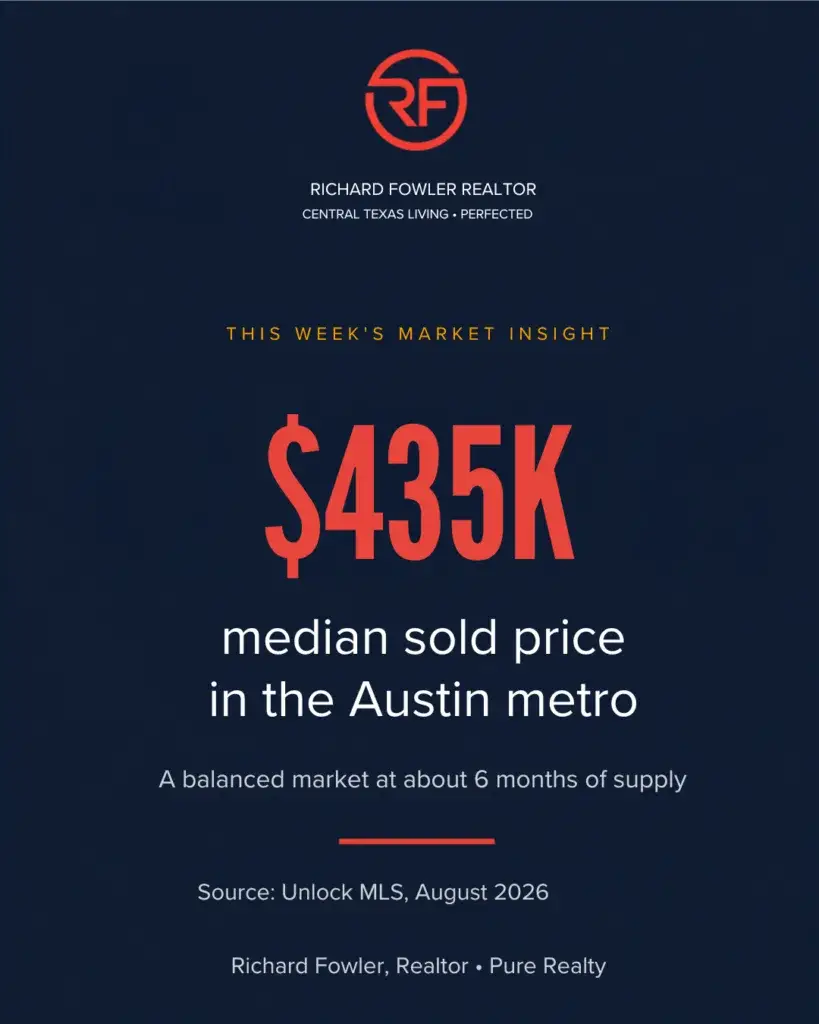
On the market side, this is the most buyer-friendly window Central Texas has seen in years. As of August 2026, the Austin metro is sitting at a balanced market of roughly six months of inventory, with a median sold price around $435,000, per Unlock MLS. Prices have pulled back from the pandemic peak, and buyers have real negotiating room again, which we simply have not had for a long time. So if you were leaning toward buying anyway, today’s market gives you leverage that buyers a couple of years ago could only dream about.
What surprises people most about Central Texas?
Property taxes. Almost every time. Folks coming from out of state see the property tax bill and blink. What I remind them, especially my clients from California, is that Texas has no state income tax, so you are usually still coming out ahead once you run the whole equation. It is a trade, not a penalty, and it is worth doing the real math instead of reacting to one line on a statement.
The other pleasant surprise is that the growth actually pays you back. Take Cedar Park, where I live. The new CedarView district off New Hope Drive is bringing a Scheels, which opens at the end of August, plus Nebraska Furniture Mart’s largest store in the country and a new Marriott hotel with a city convention center, all next to the H-E-B Center where the Texas Stars and Austin Spurs play. That kind of development widens the tax base, and a wider tax base can actually pull tax rates down over time. When I first moved to my sliver of Cedar Park, the rate was about 3.2 percent. It has dropped to a little over two as the area has grown.
How do you get a feel for an area from far away?
Technology does a lot of the heavy lifting before you ever land. I set up saved searches on the specific areas we are considering so you can watch what is really happening: the styles of homes, how long they sit, what they list for versus what they sell for, how much negotiating is going on. You start to feel the rhythm of a neighborhood from your couch in Seattle.
The rest is about your actual life, because that is what makes a place home. I once matched a family to an area because their son lived and breathed ultimate Frisbee and needed to be near it. For someone else it is cycling, or restaurants, or live music. Austin has one of the only purpose-built Formula 1 tracks in the country at Circuit of the Americas, festivals like ACL nearly every month, Austin FC at Q2 Stadium, and a food and art scene that still surprises me after all these years. Before you visit, I send you information tailored to the things you love, so the trip feels like your city already.
And when schools are the priority, that drives everything. Cedar Park sits in Leander ISD, and I have had families for whom getting into Cedar Park High School was the whole ballgame. That is often reason enough to point someone here.
If you want to go deeper on specific areas, I broke down the best Central Texas neighborhoods for families relocating for work in a separate article.
What if you are buying sight unseen?
It happens, and I can make it work. During the pandemic I had clients buy sight unseen, and the way I handle it is simple: I become your eyes on the ground. I walk the property on video, talk you through it room by room, and flag the things I would want to know about as if I were buying it myself. I still always recommend seeing a home in person if you can, because you will catch things that matter to you that I might not, and the other way around.
When you do come to town, we work efficiently. We build your top 10 or 15, and I keep it to about five or six homes a day, because after that they start to blend together and you get worn out. Some people find it on the first visit. I once showed a client one property, the very first one, and that was the house. That is rare, but it happens.
The part people forget is everything after the offer. If it is new construction, or there are repairs, or inspections to attend, I am the human who shows up. I meet the builder, I meet the contractors, I go to the inspection. That is the difference between a stressful long-distance move and one where somebody local has your back.
What is the biggest relocation mistake, and how do you avoid it?
Stress. Nearly every relocation mistake I have seen traces back to it. You are under a deadline, you feel like you have to get the house, and that pressure is exactly when people make decisions they regret. So I say this to every client: you have all the power. You do not have to pull the trigger. If you are not feeling it, we back up and rethink. A home is a huge decision, and my job is to help you reach your goals without steamrolling you to get there.
A lot of what I do is simply take the stress out. I can even help before you leave your current city by qualifying a good listing agent to sell your home on that end, so the whole move is coordinated instead of chaotic. Donna and my team feel the same way about it. We are in this for the long haul, not a single transaction.
A few questions I hear from people moving to Austin
Should I rent or buy when I first move to Austin? It depends on how sure you are of your area and your timeline. Renting for six to twelve months is a fine way to learn the city. But with today’s balanced, buyer-friendly market, buyers who are ready have more negotiating room than they have had in years.
Why are Texas property taxes so high? Texas has no state income tax, so more public funding comes through property taxes. For most people relocating from higher-tax states, the overall math still works in their favor, so it is worth running the full comparison.
Which Austin suburb is best for families? It depends on your priorities, but school district drives a lot of decisions. Cedar Park, for example, is in the well-regarded Leander ISD. The right fit comes from matching the area to your commute, schools, and lifestyle, not from a top-ten list.
Can you help me buy a home in Austin before I move there? Yes. I do video tours, set up saved searches so you can follow the market from afar, and act as your boots on the ground for showings, inspections, and new-construction meetings.
The Bottom Line
Relocating to Austin is not about finding a house, it is about finding the right corner of a big, weird, wonderful region for your life. Start with your goals, use today’s buyer-friendly market to your advantage, and do not let the stress of a deadline make the decision for you. If you are thinking about a move to Central Texas, reach out. Donna and I will give you a straight, no pressure read on the areas, the market, and the timing that fit you.
Written by Richard Fowler, REALTOR with the ARK Property Team at Pure Realty. Published August 2026.