
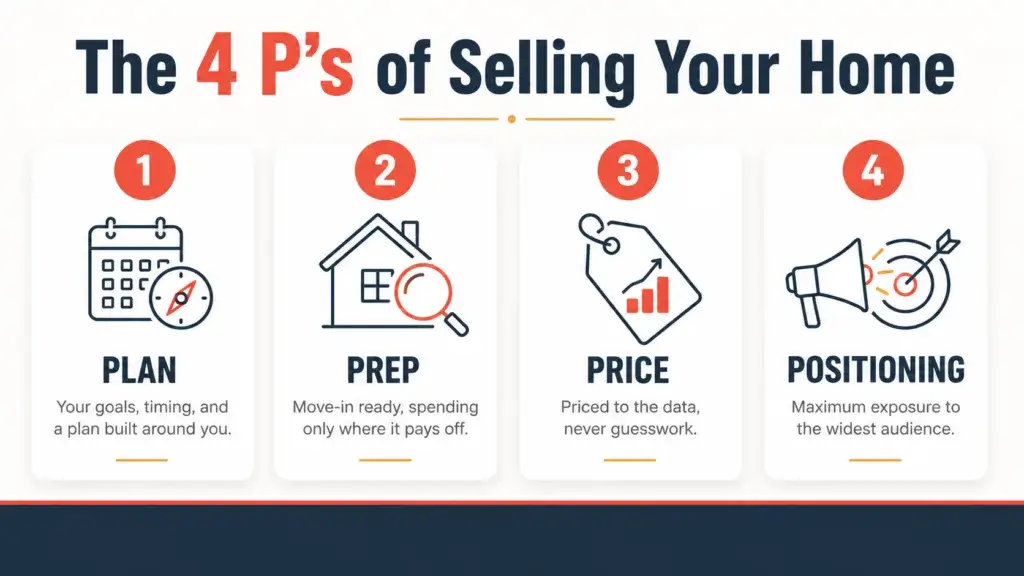
Most people think selling a home is simple. You put a sign in the yard, you wait for offers, and you take the best one. That approach worked during the pandemic, when a house could get 40 offers in its first 12 minutes on the market. It does not work today. This week Jeff finally pinned me down to lay out my entire process in one place, the way I actually list a home, and it comes down to four steps: Plan, Prep, Price, and Positioning. Here is how each one works, and why the order matters.
KEY TAKEAWAYS
Selling well starts long before the sign goes up, with your goals, your timing, and a prep plan built around return on investment, not just spending money. Price to the current data, not to what your neighbor got in 2021, because in a market where more than half of listings are cutting their price, overpricing means you sit and usually lose. And the whole game is positioning the home to the widest possible audience, which is why that bright red wall probably needs to go.
Why does selling start before you fix anything?
The first step is not prep. It is planning: your goals, your objectives, and your timing. Those three things shape everything that follows. I had a seller come to me last October who wanted to move from Austin to Dallas but did not have to be there by any particular date. They were trying to decide whether to sell at the end of the year or wait. Because they had flexibility, and because a new job and a holiday move would have piled on stress, I told them the spring market made the most sense. That gave us the winter to do the interior work calmly instead of scrambling. If your situation is different, we adjust. I have put a house on the market in 10 days when someone needed to move fast. The point is that the plan comes first, and it is built around you, not a template.
How do you prep a home without wasting money?
Every recommendation I make comes back to one thing: return on investment. I am not here to tell you to spend money. When a client asks if they should do something that will not pay off, I tell them not to. My job on a walkthrough is to inventory each room and separate what actually moves the needle from what does not.
This is also where I always recommend a pre-listing inspection, what I like to call getting a Carfax report on your house. There are things behind the walls you may not know about, and a third party report from a licensed inspector carries far more credibility with a buyer than a seller’s own disclosure. Just as important, it puts you in a strategic position instead of a reactive one. If you skip it, you find out about the wood rot or the broken window seals when the buyer’s inspector calls them out during the option period, and now you are negotiating from your back foot. And no, an inspection does not mean you have to fix everything. You are selling your house, so you hold the power. You can fix everything, fix nothing, or, like most people, go down the middle. It is all a negotiation.
Prep also runs straight into budget. I had a client with about 60 windows, roughly 30 of which had broken seals. We priced out the replacement, and when the budget was not there, we adjusted the list price to account for it instead. You cannot get top dollar with 30 broken seals, but you can price around them honestly.
When people ask what actually adds value, the answer is that it is always cents on the dollar. Spend 120,000 dollars on a pool and you will not get 120,000 back. The concentrated areas that matter are the kitchen, the primary bedroom, and the primary bath, with the kitchen giving you the strongest return. But for most sellers we are not talking about a remodel. We are talking about flooring or a carpet allowance, and above all, curb appeal. On one recent listing we power washed the exterior, cut down an ugly cedar tree that was actually damaging the roof, touched up the paint around the front door, and replaced the original 2006 lantern with a 75 dollar one. Little things, done for very little money, that make a buyer fall for the house before they even walk in.
How do you land on the right price?
I price to data and trends, not to feelings, and not to what your house sold for in a different market. This has been the hardest conversation in Austin for a few years, because everyone got used to pandemic prices and nobody wants to give them up. But the data is blunt. Per Unlock MLS, more than half of the active listings in our area, about 55 percent as of this summer, have already taken a price cut. And the longer a home sits, the deeper those cuts usually go. When you overprice out of the gate, you do not just sit, you get pulled into a cycle of price drops and usually end up lower than if you had priced it right the first time.
The market itself has shifted, too. We have climbed back to roughly six months of inventory, which is a genuinely balanced market, something Austin had not seen in a long time. That gives buyers real leverage, especially on overpriced homes, and it feeds a kind of analysis paralysis where buyers see so many choices and so many price drops that they keep waiting for the next deal. Sometimes that works out for them, and sometimes they wait themselves right out of the home they wanted. When I set a price, I usually give a range and we decide the strategy together: push for top of the market and accept it may take longer, price at the bottom to trigger multiple offers, or aim for the middle. What I will not do is pick a number out of the air. It is your decision, but I am going to show you the data behind it.
What does it mean to position and market the home?
Positioning is about opening the home to the widest audience possible, and that often means setting your personal taste aside. The classic example is the red wall. I had clients with a bright red curved staircase that was the backdrop for the whole living area, plus a nearly black bedroom upstairs. The husband did not want to change a thing. We finally agreed that once the house sold, they could go as red as they wanted in the next one. We repainted, and the house sold in less than 72 hours. I have had the same conversation about everything from a media room that needed to become a neutral flex space to walls covered in crosses. I always frame it the same way: this is not a judgment on your taste or your beliefs, it is a real estate answer to a real estate question, and the goal is to reach every possible buyer. From there, marketing is table stakes. The home gets professional photos and gets syndicated everywhere, in front of as many people as we can reach, and then we go to market.
Why does the right agent matter through all of this?
Because the process only works if someone is actually running it, start to finish. I am not the agent who makes the listing presentation and then disappears until the closing table. There is a checklist well over a hundred steps long that runs in the background of every sale, and a client might only ever see ten of them. For me it is business, but it is personal. When someone trusts me with something this big, it is on my mind at three in the morning. One of my most important jobs comes down to a simple truth: buying and selling a home is inherently stressful, and I do everything I can to take that stress off of you.
A few questions I hear all the time
Do I really need a pre-listing inspection? I strongly recommend it. It gives you credibility with buyers and lets you go into the transaction strategically instead of reacting to their inspector during the option period.
Do I have to fix everything an inspection finds? No. You hold the power as the seller. Most people fix the important items and negotiate the rest.
What actually adds value before selling? Curb appeal and clean, neutral, move-in-ready interiors give the best return. Big projects like a pool rarely pay for themselves.
Is now a good time to sell in Austin? It can be, if you price to the current data. With more than half of listings cutting prices, the sellers who win are the ones who position correctly from day one.
The Bottom Line
Selling a home the right way is a process, not a sign in the yard: plan around your goals, prep for return on investment, price to the data, and position to the widest audience. Do those in order and you protect both your money and your sanity. If you are thinking about selling in Central Texas, reach out and Donna and I will give you a straight, no pressure read on your home and your timing.
Written by Richard Fowler, REALTOR with the ARK Property Team at Pure Realty. Published August 5, 2026. Last updated August 5, 2026.