The right realtor is the one who fits your personality, communicates consistently, stays in their lane, and prices your home based on data instead of your hopes. Before you hire anyone, ask about their experience, whether they work both sides of the deal, and how they handle the parts of a transaction you never see. And pay attention to one thing above all: the best agent for you will tell you the truth, even when it is not what you want to hear.
Picking a realtor feels simple until you are in the middle of a deal with the wrong one. Most people go with the first name they recognize, or the agent who promises the highest price. Both are easy ways to get burned. So let me walk you through how I actually think about this, using the same stories and standards I share with my own clients.
What does a great agent really do that you never see?
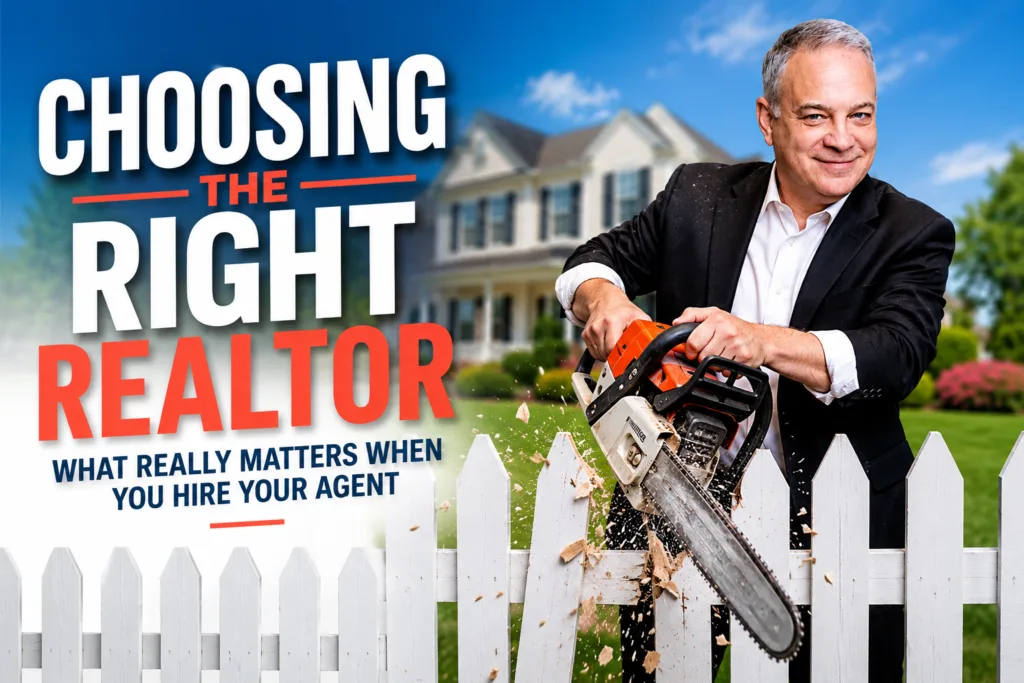
More than you would guess. On one of my very first deals, a VA appraiser rejected the house because a wooden fence sat less than a quarter inch from the brick. The seller was out of the country, so I drove across town, bought a saw, cut the section off myself, sent a photo to the appraiser, and we closed. I had been in real estate about a minute and I was pretty sure I was headed to jail for sawing on somebody’s fence. But that is the job.
A while back I sent Jeff a list of 184 separate things a good agent manages in the background of a single transaction. In most cases the client never realizes any of it happened, and a lot of the time we are quietly covering those things on their behalf. I have run properties for months for clients who were out of the country, letting contractors in and out and making sure the water was running. On a million-dollar listing, I was out front planting the pots myself, because curb appeal is the very first thing a buyer sees when they pull up.
Sometimes it is bigger than errands. My partner Donna and I will often stage a home to get it ready to sell, and more often than not we do it with the owner’s own furniture, just repositioned. Clients walk back in and tell us the house looks better than it did that same morning. We have actually lost a couple of listings that way, we staged the home so well that the owners decided they did not want to move after all.
What is the biggest red flag when choosing an agent?
Personality. If you are talking with an agent and you are just not feeling it, trust that. Working a transaction together is a little like going through boot camp. It can be stressful, things come up, and a good agent works hard to limit how much of that stress lands on you. If it already feels off in your first few conversations, it is better to call it right then than to discover it in the middle of something serious, with a contract on the table.
The flip side of that is communication, and it might be the single most important thing. I believe in erring on the side of over-communication, and I tend to talk with my clients two or three times a week through a deal. By the end, people tell me they do not know how they are going to get by without the calls. Do not just take an agent’s word for this, either. Read their reviews and see what clients actually say. Mine tend to write long ones, and the word that comes up again and again is communication.
I also remind clients of something that takes the pressure off: you are in control. You do not have to buy if you do not want to buy, and you do not have to sell if you do not want to sell. My job is to collaborate, educate, and make recommendations. The decision is always yours.
What questions should you ask before you hire an agent?
Start with experience. How long have they been in the business, what do their sales actually look like, and do they know your specific area? I am a big believer in working both listings and purchases. A lot of agents want to live only on the listing side, but being in the trenches on both makes me better, because I can see around the corners of a deal before it gets there.
Ask for real numbers. I have done more than $80 million in real estate in 13 years, and when I split that between purchases and listings, the two sides came out within $200,000 of each other. If an agent cannot speak clearly to their own track record, treat that as a red flag.
One more question worth asking: will the person you meet at the listing appointment actually be the one who handles your sale? I do not build out a big team and hand you off. I stay involved in most of the communication and I am with you through the entire process, and honestly well beyond it. You become a client for life, the person I call when I need a good roofer and the person who calls me when they need one.
Where do one-size-fits-all agents get people in trouble?
When they chase business outside their expertise. I do residential, farm and ranch, and strategic land and development work. I do not do triple net commercial, so when a client asks me to, I tell them the truth: that is beyond my wheelhouse, and I do not look good in orange, so let me connect you with someone who does it well. Good brokerages reinforce that discipline, and Pure Realty is one of them. The order of priority never changes: take care of the client, then do no harm, to the client, to yourself, or to the brokerage.
What does “go by the data” actually mean?
It means I price your home off comparable market data and current trends, not off a number from Zillow or off a feeling. Part of that is just how I am wired. Before real estate, I earned a degree in accounting and spent 25 years selling to Fortune 500 companies, so I look at the numbers first and let them lead.
And the numbers matter, because real estate is deeply personal, which is exactly why the data has to be the anchor. I have watched a multimillion-dollar deal nearly fall apart over who was going to get grandma’s rocking chair. I have seen two nearly identical homes in the same neighborhood, within 300 square feet of each other, sell for $520,000 and $680,000. Per the Unlock MLS Central Texas Housing Report, Williamson County was running around 4.4 months of inventory in June 2026, up from a year earlier. More inventory means buyers have more choices, and a home priced above what the data supports is the one that sits and takes reduction after reduction. Price it right the first time and you usually come out ahead of the seller who chased a high number all the way down.
The data protects you from surprises, too. Take pools. During the pandemic a lot of them went in fast, some with mortar that was not mixed correctly, and now we are seeing real problems with pools failing a few years in. At Pure Realty we even have a disclosure clients sign about it. If a pool is on your must-have list, the due diligence really matters.
Why would a good agent ever walk away?
Because the fit has to work both ways. I once gave a listing presentation to a former executive who was used to controlling every situation. He wanted the Zillow number, and the data said he was $40,000 to $50,000 high. He looked me dead in the eye and asked how he could fire me, before we had even started. I laughed, told him exactly how, and then told him that I could fire him too, if he would not follow the recommendations we agreed on together. He was a little surprised, but we ended up working well together. A nicer home came on the market up the street at a higher price, it helped pull his value up, and I got him the number he wanted after all. Straight talk at the very beginning is what made the whole thing work.
A few questions I hear all the time
Should I just hire the agent who quotes the highest price? No. The highest listing number is not the same as the highest sale. Overpricing usually leads to sitting on the market and cutting the price anyway, often ending up below where you would have landed if you had priced it right on day one.
How many agents should I interview? Enough to find the right fit. Credentials and sales history matter, but personality and communication style matter just as much, because you are going to spend real time together under some pressure.
Does it matter if an agent only does listings, or only works with buyers? It can. An agent who works both sides sees the whole board and tends to anticipate problems earlier in the deal.
What if my agent and I disagree on price? We go back to the data, and if we are still apart, an independent appraisal can settle it. I would rather have that conversation up front than list at a number I cannot defend.
The Bottom Line
The right realtor for you is the one who fits how you like to work, communicates more than you expect, stays in their lane, and prices off the data even when it is not the answer you were hoping for. If you were my brother, I would tell you the same thing. If you want a no-pressure conversation about buying or selling in Central Texas, reach out and let’s talk it through it Our Contact Page.
Written by Richard Fowler, REALTOR with the ARK Property Team at Pure Realty. Published July 22, 2026. Last updated July 22, 2026.