

Every Austin homeowner thinking about upsizing is stuck on the same question right now:
“Should I buy now at 7%, or wait and see if rates drop?”
It’s keeping you up at night. You’re doing the math over and over. Maybe you’ve even put your upsizing plans on hold, hoping that magical 5% rate will return.
Here’s the thing—while you’re waiting for the perfect rate, Austin’s market isn’t standing still. And the cost of waiting might be higher than you think.
Let’s cut through the noise and look at what really matters for your upsizing decision.
Table of Contents
The Real Math Behind Interest Rates and Buying Power
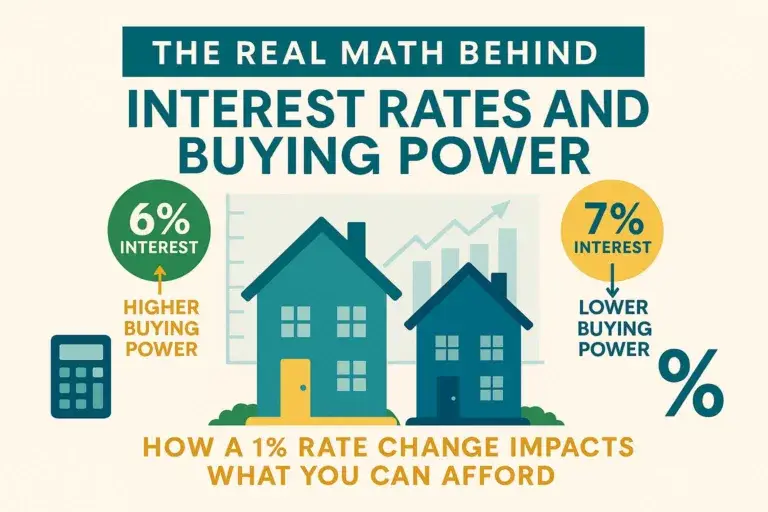
First, let’s get clear on how rates actually affect your purchasing power. This isn’t theory—it’s the reality of what you can afford.
The 1% Rule: Every 1% increase in rates reduces your buying power by roughly 10-12%.
Here’s what that looks like with real Austin numbers:
Interest Rate | $900K Home Monthly Payment | Max Home Price at $5,000/mo |
5.5% | $4,565 | $985,000 |
6.5% | $5,056 | $890,000 |
7.5% | $5,573 | $810,000 |
Assumes 20% down, 30-year fixed, including taxes/insurance
That’s a $175,000 swing in buying power between 5.5% and 7.5%. Ouch.
But here’s where it gets interesting…
The Hidden Cost of Waiting: Austin's Appreciation Factor
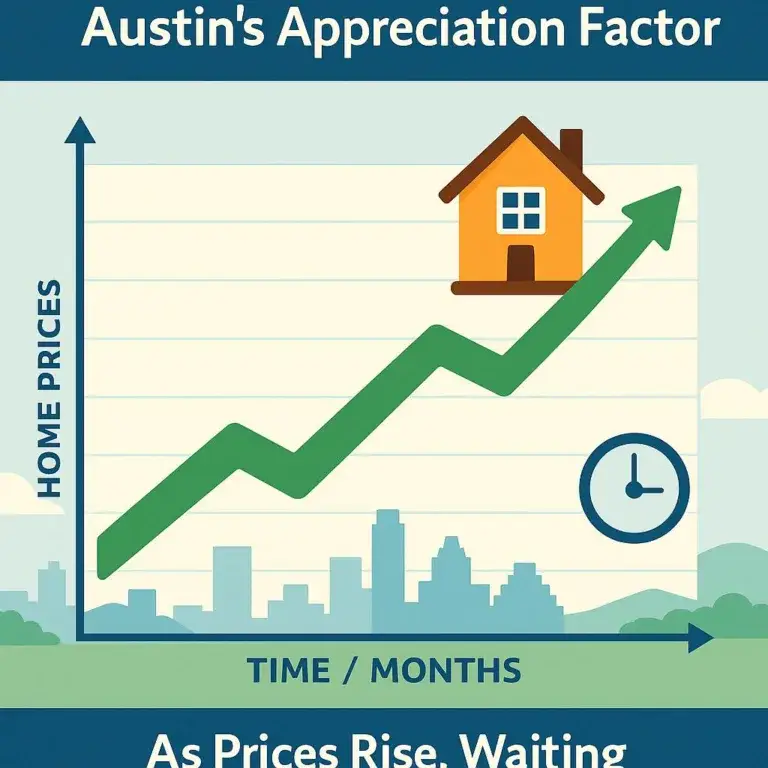
While you’re waiting for rates to drop, Austin home prices keep climbing. Even in “slow” years, we’re seeing 3-5% appreciation. In normal years? 7-10%. Sometimes more.
Let’s run a realistic scenario:
Scenario: The Waiting Game
You’re eyeing a $900,000 home in Circle C today at 7% interest.
- Monthly payment: $5,573
- Total interest over 30 years: $706,000
You decide to wait a year, hoping rates drop to 6%.
- The home appreciates 5% to $945,000
- Your new monthly payment at 6%: $5,347
- Total interest over 30 years: $679,000
The result? You saved $226/month and $27,000 in total interest. But you paid $45,000 more for the house. And that’s assuming just 5% appreciation—historically, Austin has often exceeded that.
Why Austin's Market Doesn't Follow National Trends

Here’s what the national real estate blogs won’t tell you: Austin plays by different rules.
The Austin Reality Check:
- Tech Employment: When Apple, Tesla, and Oracle expand, they bring high-earning buyers who care more about the monthly payment than the rate
- California Exodus: Cash buyers from the West Coast don’t care about your mortgage rate
- Limited Inventory: With everyone holding onto their 3% mortgages, fewer homes are hitting the market
- Population Growth: Austin metro adds 150+ people per day—they all need somewhere to live
This creates a perfect storm where waiting for rates often means paying more later, even if rates do drop.
The "Golden Handcuffs" Creating Your Opportunity

Right now, 82% of Austin homeowners have mortgage rates below 5%. Most are below 4%. They’re not moving unless they absolutely have to.
This creates a weird market dynamic:
For Sellers (That’s You): Your home faces less competition. Fewer listings mean your property stands out. Multiple offers are back in many neighborhoods, especially under $800K.
For Buyers (Also You): Yes, there’s less inventory, but there’s also less competition from other buyers. The investors have pulled back. The casual upgraders are sitting out. If you’re serious and prepared, you have negotiating power you didn’t have two years ago.
The Strategy Smart Austin Professionals Are Using

nstead of waiting for perfect conditions, savvy upsizers are using a three-part strategy:
1. Buy Now, Refinance Later
Lock in the home you want today. When rates drop (and historically, they always cycle), refinance. Even a 1% drop could save you $400 to $ 500/month. Meanwhile, you’re building equity and enjoying your new space.
2. Negotiate Like It’s 2010
Sellers know the rate situation. They’re more flexible than they’ve been in years. Ask for:
- Rate buydowns (seller pays to lower your rate for 1-3 years)
- Closing cost credits
- Home warranties
- Repair allowances
One recent client got the seller to cover a 2-1 buydown, saving them $800/month for the first year and $400/month the second year. That’s $14,400 in savings.
Traditional 30-year mortgages aren’t your only option:
- 7/1 ARM: Lower rate for seven years (perfect if you might move again)
- 2-1 Buydown: Seller-paid reduced rates for two years
- Interest-Only HELOC: For a down payment while selling the current home
- All-Cash Bridge: Borrow to buy cash, then get a traditional mortgage after closing
Real Austin Examples: Waiting vs. Acting
The Johnsons: The Cost of Perfect Timing
Mueller → Still in Mueller (Smaller Home)
Mike and Sarah Johnson had been watching rates like hawks since early 2018. They lived in a 1,400 sq ft home in Mueller with their two kids, and the walls were closing in. When rates hit 4.5% in 2018, they thought it was too high—after all, their current mortgage was 3.8%.
“Let’s wait for rates to drop back down,” Mike said. They waited through 2018. Then 2019. Rates did drop to 4.2%, but they held out for under 4%.
Then 2020 hit. Rates plummeted to 3.2%—perfect! Except now, the 2,400 sq ft Mueller home they’d been eyeing had gone from $750K to $890K. Worse, they were now competing with 15 other offers, many cash, many waiving inspections.
They lost five bidding wars before finally giving up. Today, they’re still in the same 1,400 sq ft home, now with two teenagers sharing a room. That dream home? It’s worth $1.1M now. They saved $180/month by waiting for the perfect rate but priced themselves out of their own neighborhood.
“We optimized for interest rate and lost the war,” Sarah told me recently. “Our kids spent their entire childhood in a house that was too small because we were waiting for the perfect rate.”
The Patels: Acting Despite the Rate
Travis Heights → Avery Ranch
Raj and Priya Patel faced the opposite decision in early 2023. Rates had just hit 7.2%, and everyone—literally everyone—told them to wait.
But their Travis Heights condo was bursting. With two kids under 5 and both working from home, they were scheduling Zoom calls around nap times and using the bathroom as a phone booth. Something had to give.
Instead of waiting, they got strategic. They found a 3,200 sq ft home in Avery Ranch listed at $825K. It had been sitting for 21 days (an eternity in the old Austin market). They offered $800K with aggressive terms: $15K in seller credits for closing costs, a 2-1 rate buydown paid by seller, and a $5K repair allowance.
The seller, who’d already moved to Dallas for work, accepted immediately.
Their first-year payment? $4,200/month instead of $5,000, thanks to the buydown. When rates dipped to 6.3% just 10 months later, they refinanced, bringing their payment to $4,600—still higher than if they’d gotten a 5% rate, but manageable.
“The best part?” Raj says. “We’ve been enjoying this house for over a year now. My son has his own room. We have an office. There’s a backyard. You can’t put a price on that quality of life. Meanwhile, our friends who are still waiting? They’re still waiting, and similar houses in Avery Ranch are now $875K.”
The Williamses: The Hybrid Approach
South Lamar → Dripping Springs
Tom and Ashley Williams took a middle path that’s worth considering. In mid-2022, they watched rates climb from 5% to 6% to nearly 7%. Instead of panicking or paralyzzing, they created what they called their “rate ladder strategy.”
They owned a $500K bungalow near South Lamar, bursting with three kids. They wanted land in Dripping Springs but weren’t willing to overpay just because of rates.
Step 1: They got their South Lamar home perfectly market-ready but didn’t list it. Step 2: They got pre-approved at 6.8% and knew their absolute max payment. Step 3: They made three strategic offers on overpriced Dripping Springs properties, all contingent on selling their home, all 10-15% under asking.
Two sellers laughed them off. The third—a relocated California family who’d been sitting on market for 67 days—negotiated.
They ultimately bought a 4-acre property with a 3,500 sq ft home for $865K (listed at $975K). The seller covered a 1% rate buydown. They listed their South Lamar home the day after going under contract and sold it in 4 days for $15K over asking.
“We weren’t trying to time the market perfectly,” Ashley explains. “We were trying to find the sweet spot where seller desperation met our financial comfort zone. The rate mattered less than getting the right deal on the right property.”
Eighteen months later, their home has appreciated to roughly $920K, their kids have space to roam, and Tom’s using a barn as his workshop. They’re planning to refinance when rates hit 5.5%—if they ever do. If not? They’re still happy.
Your Personal Rate vs. Waiting Calculator
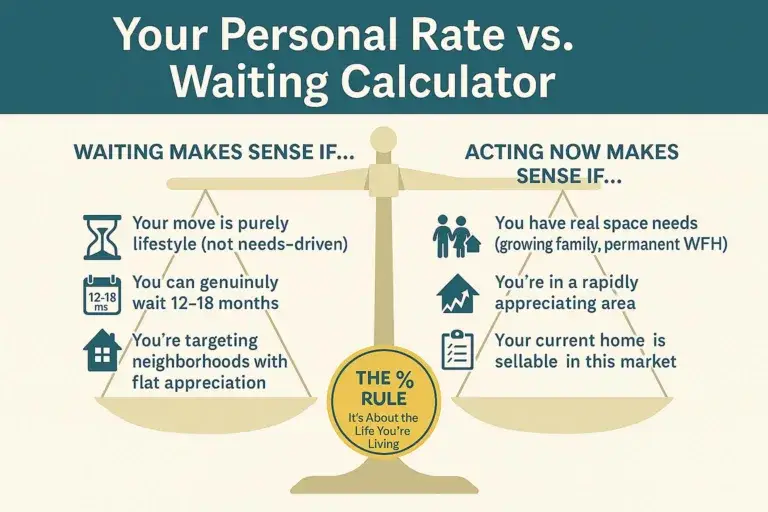
Here’s how to figure out if waiting makes sense for YOU:
Waiting Makes Sense If:
- Your move is purely lifestyle (not needs-driven)
- You can genuinely wait 12-18 months
- You’re targeting neighborhoods with flat appreciation
- You have a specific rate threshold that changes everything (like qualifying for a jumbo loan)
Acting Now Makes Sense If:
- You have real space needs (growing family, permanent WFH)
- You’re in a rapidly appreciating area
- Your current home is sellable in this market
- You can afford payments at current rates (even if not ideal)
The 5 yr Rule: If you can afford the payment at current rates and the home meets your needs for the next 5+ years, the rate becomes less important than the life you’re living.
What About the Fed? (And Why It Matters Less Than You Think)
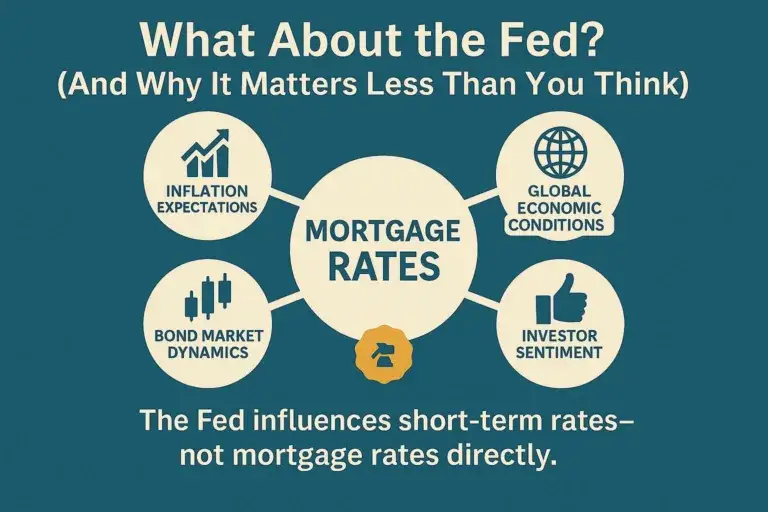
Everyone’s watching the Fed, hoping for rate cuts. But here’s the disconnect:
The Fed controls short-term rates. Mortgage rates follow the 10-year Treasury, which responds to:
- Inflation expectations
- Global economic conditions
- Bond market dynamics
- Investor sentiment
The Fed could cut rates three times and mortgage rates might barely budge. We saw this in 2019—Fed cut, mortgage rates went up.
Bottom line: Don’t bet your family’s housing needs on Fed meetings.
Market Timing vs. Life Timing
Here’s something I learned from 20 years in this business: The best time to buy is when you’re ready—financially and emotionally—not when the market is “perfect.”
Think about it:
- Parents who waited for lower rates in 2021 are still waiting, while their kids have outgrown two bedrooms
- Couples who bought in 2018 at 4.5% thought rates were “too high”—now they’re sitting pretty
- Everyone who waited for prices to drop in 2010 watched Austin double instead
Your life is happening now. Your kids are growing now. Your home office needs are real now.
The Smart Upsizer's Action Plan
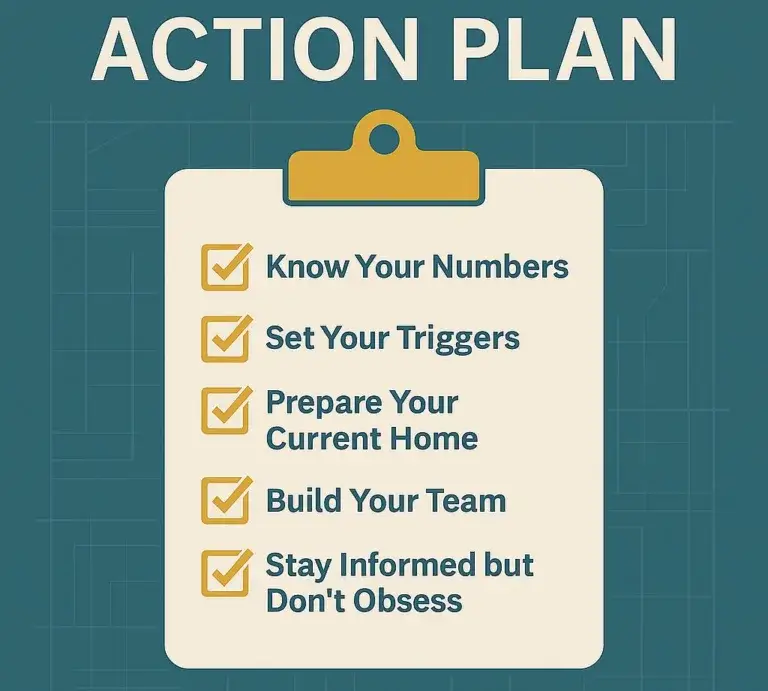
If you’re serious about upsizing in the next 12 months, here’s your playbook:
Step 1: Know Your Numbers (Really)
- Get pre-approved at current rates
- Calculate payments at +/- 1% to see your range
- Factor in Austin property taxes (they’re no joke)
Step 2: Set Your Triggers
- Define the maximum rate you’ll accept
- Set your target neighborhoods and price ranges
- Decide your “must move” deadline
Step 3: Prepare Your Current Home NOW
- Even if you’re waiting, get it ready
- Markets move fast—when you decide to go, be ready to list immediately
- Read: Why Talk to an Agent Before Remodeling →
Step 4: Build Your Team
- Interview lenders who understand creative financing
- Find an agent who’s navigated rate changes before
- Read: How to Find the Right Austin Realtor →
Step 5: Stay Informed but Don’t Obsess
- Check rates weekly, not daily
- Watch your target neighborhoods’ inventory
- Track Austin employment news (tech layoffs = opportunity)
Your Move: The Decision Framework
Stop asking “Should I wait for rates to drop?”
Start asking:
- Can I afford the payment at today’s rates?
- Will waiting cost me more in appreciation than I’ll save in interest?
- What’s the real cost to my family of staying in our current home another year?
- Am I prepared to act fast when my trigger conditions are met?
If you answered yes to the first question and did the math on the second, you have your answer.
The Bottom Line on Austin Interest Rates
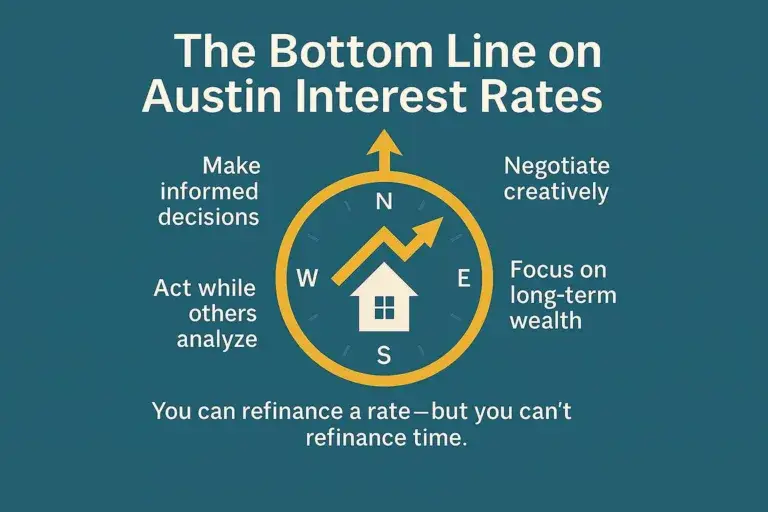
Rates matter. But they’re not everything.
In Austin’s dynamic market, with our population growth, limited inventory, and steady appreciation, waiting for the perfect rate often means paying more later.
The winners in this market aren’t the ones who time it perfectly—they’re the ones who:
- Make informed decisions based on their situation, not headlines
- Negotiate creatively in the current environment
- Focus on long-term wealth building over short-term payment optimization
- Actually make the move while others are still analyzing
Remember: You can refinance a rate. You can’t refinance time with your family in a home that fits your life.
Ready to Run YOUR Numbers?
Every situation is unique. General advice only gets you so far. You need specifics for your situation, your neighborhoods, and your timeline.

Download our Complete Move-Up Guide →
Inside, you’ll find:
- Rate comparison calculators for your exact scenario
- Financing strategies worksheets
- Month-by-month market timing guides
- Scripts for negotiating rate buydowns
- Real examples of Austin families who navigated rate changes successfully
Plus, you’ll get our monthly Austin Rate Watch report—tracking not just rates, but how they’re affecting real buyers and sellers in your target neighborhoods.
Do you have specific questions about your upsizing timeline and current rates? Schedule a free consultation, and let’s map out your options. No pressure, just clarity on what’s possible in today’s market.
← Back to the Complete Austin Upsizing Guide
Richard Fowler
Helping Austin Families Navigate Every Market Since 2010
Realty Austin – Compass